Overview
This is the one period of Japanese dress whose rules survive in full, because the eighth-century codes were written down and kept. Dress was graded by occasion: raifuku for state ceremony, chofuku for ordinary attendance at court, seifuku for those on duty. Each grade fixed colour, fabric and ornament by rank, so the clothes worked as a uniform for a bureaucracy that had just been built. Colour did most of the work — the deepest purples and reds sat at the top, and a man could not simply buy his way up the scale.
How it is worn
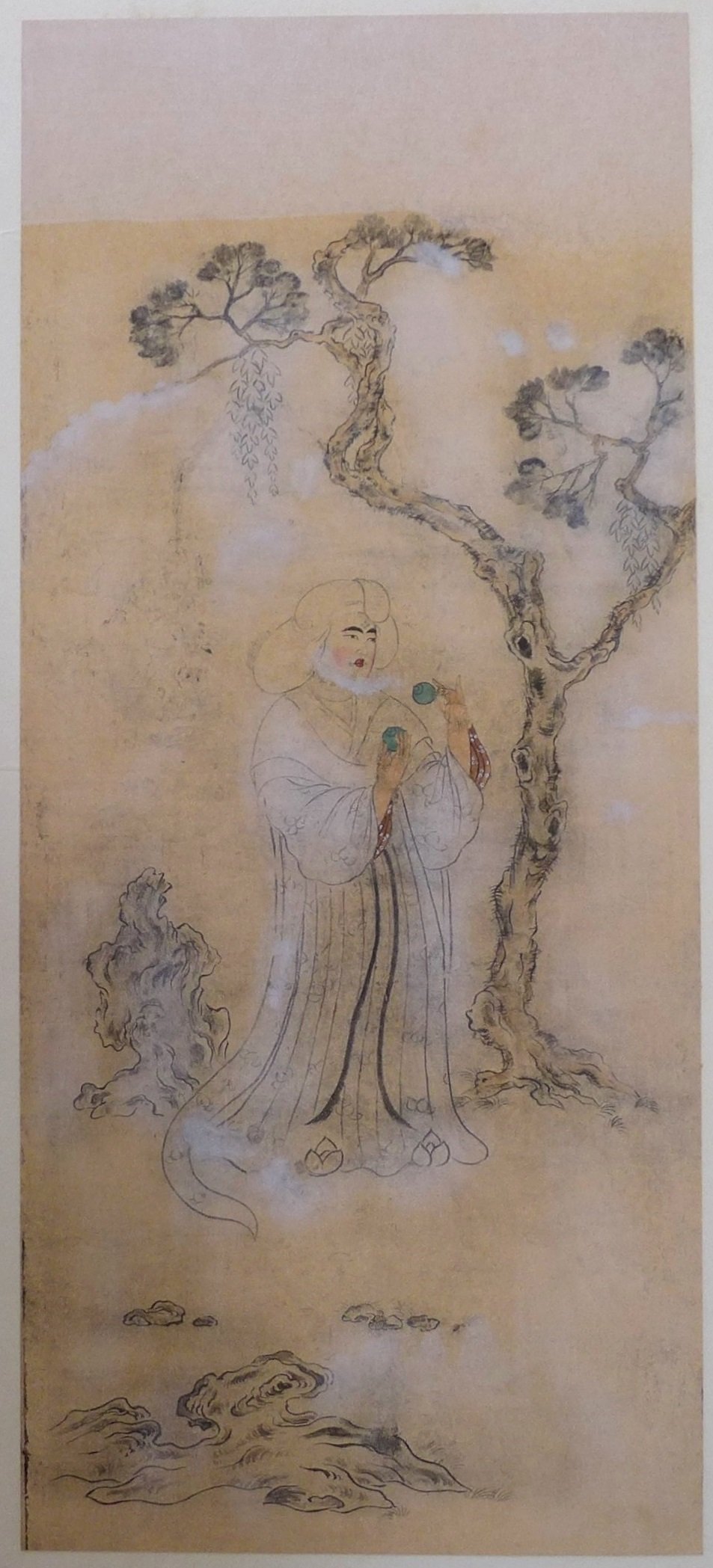
The women’s silhouette is the one that reads at a glance: a hip-length jacket with wide sleeves, worn over a long skirt whose waist has climbed to just below the arms, and a narrow stole called a hire hanging over both shoulders. Men wore a round-collared robe over trousers with a black lacquered cap. The court also legislated the wrapping direction — an edict of 719 required robes to be crossed with the right side underneath, the Chinese way — and Japanese clothing has closed left over right ever since.
History
Nara is also the only early period whose actual garments exist. The Shosoin treasury at Tōdai-ji has kept textiles, shoes and masks donated after Emperor Shomu’s death in 756, sealed and inventoried, and they confirm what the codes describe. The painted screen on this page comes from the same collection: a woman under a tree in the high-waisted skirt of the period, her robe once feathered with the plumage of the copper pheasant, most of which has since fallen away.