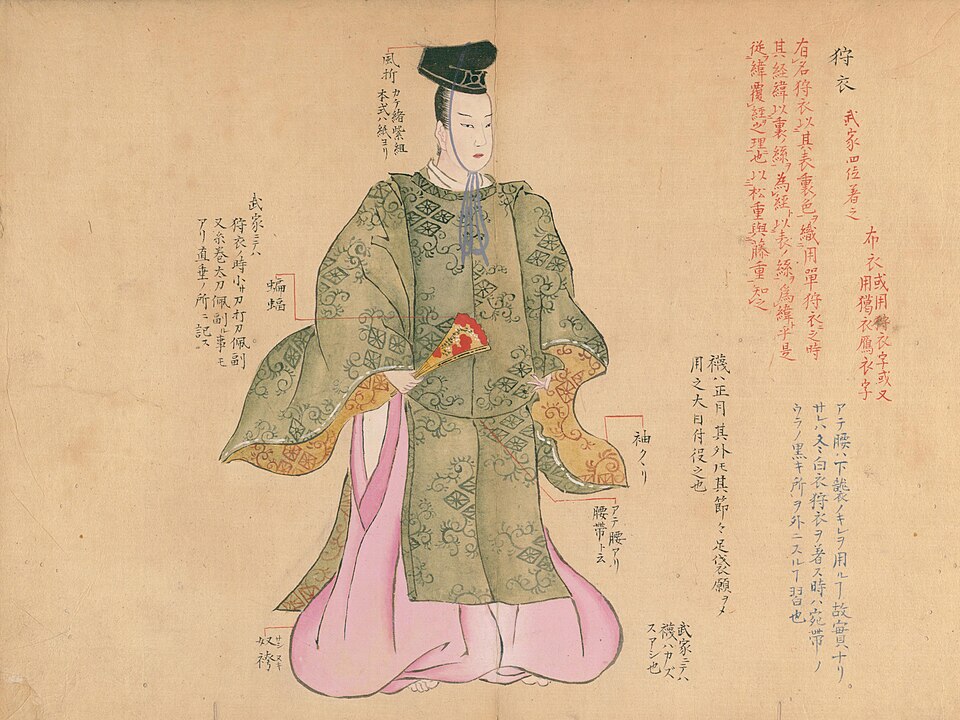
Overview
It has a round neck fastened at the right shoulder, and sleeves attached to the body along only a short seam at the top, so the arm can be pulled free through the open underside. The sleeve ends carry a drawstring, the sodegukuri, which gathers the cuff and can be tightened for work. Cut generously and worn loose over the sashinuki trousers, it is patterned silk for rank and plain for lesser wear, with colour and weave rather than shape carrying the status.
How it is worn
It goes over an undergarment and is tied at the waist, with the trousers gathered at the ankle by their own cords. The sleeve is the working part: pulled up and tied back through the drawstring for archery or riding, let down and spread for sitting. Because the sleeve is only lightly attached, the whole robe moves with the shoulders rather than with the arms, which is what makes it comfortable and what makes it look unhurried.
History
It appears in the Heian period as a hunting robe, its openness a practical answer to a garment worn on horseback, and rises through the same period into the standard informal dress of court men — a promotion that is common in clothing and rare in court dress. By the Kamakura period it had been overtaken by the hitatare among warriors. It survives because Shinto ritual dress fixed the medieval forms, and the kariginu is now standard priestly wear.