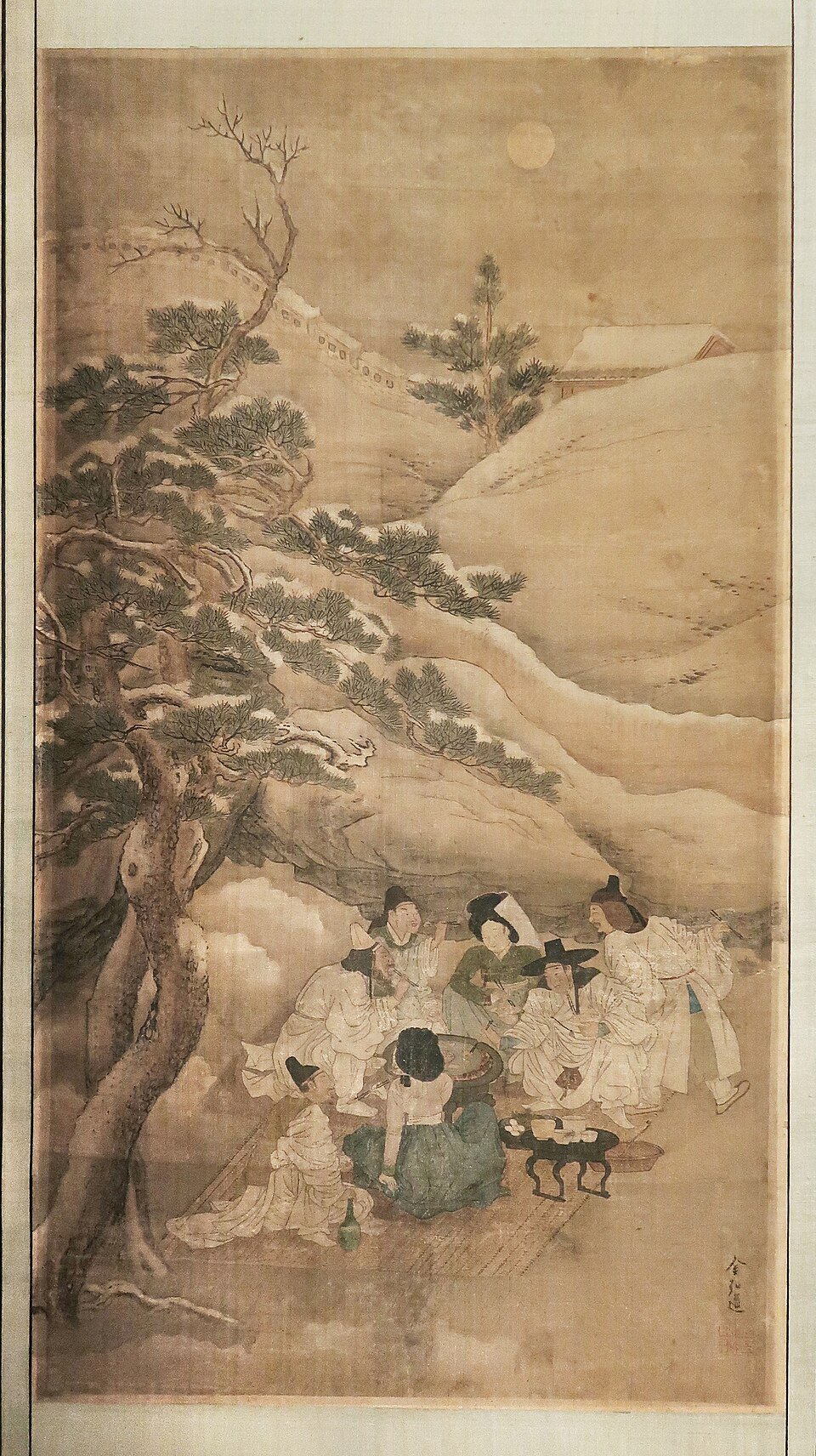
Overview
Joseon is where the hanbok reaches the proportions now thought of as classic, and the change is dramatic: over five centuries the women’s jacket shrinks from hip length to barely covering the bust, while the skirt rises and swells beneath it. Confucian order governed the wardrobe, and white was so general that Koreans were known as the white-clad people.
Key garments and style
The women’s outfit is the very short jeogori, tied with a long ribbon, over the chima gathered high on the chest — a silhouette that is almost all skirt. Men wore jeogori and baji under the durumagi coat, and out of doors the gat, a wide-brimmed hat of horsehair and bamboo so fine it is translucent.
Officials wore the hyungbae, an embroidered rank badge on chest and back, cranes for civil office and tigers for military.
Two excesses are documented because the state moved against them. The gache, an enormous wig of braided false hair, grew heavy enough to injure wearers and was restricted by royal edict in the eighteenth century. Ornament otherwise concentrated in the norigae, a knotted pendant hung from the jacket tie.
Ramie and hemp for summer, cotton and silk for winter, with undyed cloth ordinary and colour reserved by rank and occasion.
Transition
With the Korean Empire and the opening of the country, Western uniform entered the court, and the reformed hanbok of the colonial decades followed.