Overview
Mycenaean Greece is the one Bronze Age culture whose clothing industry can be read in its own accounts. The Linear B tablets from Knossos and Pylos are palace bookkeeping, and a great deal of that bookkeeping is about cloth: flocks counted in the tens of thousands, wool issued against expected returns, named fabric types, and gangs of women recorded by craft — spinners, carders, weavers, flax workers, finishers. Dress here is not only a matter of pictures.
Key garments and style
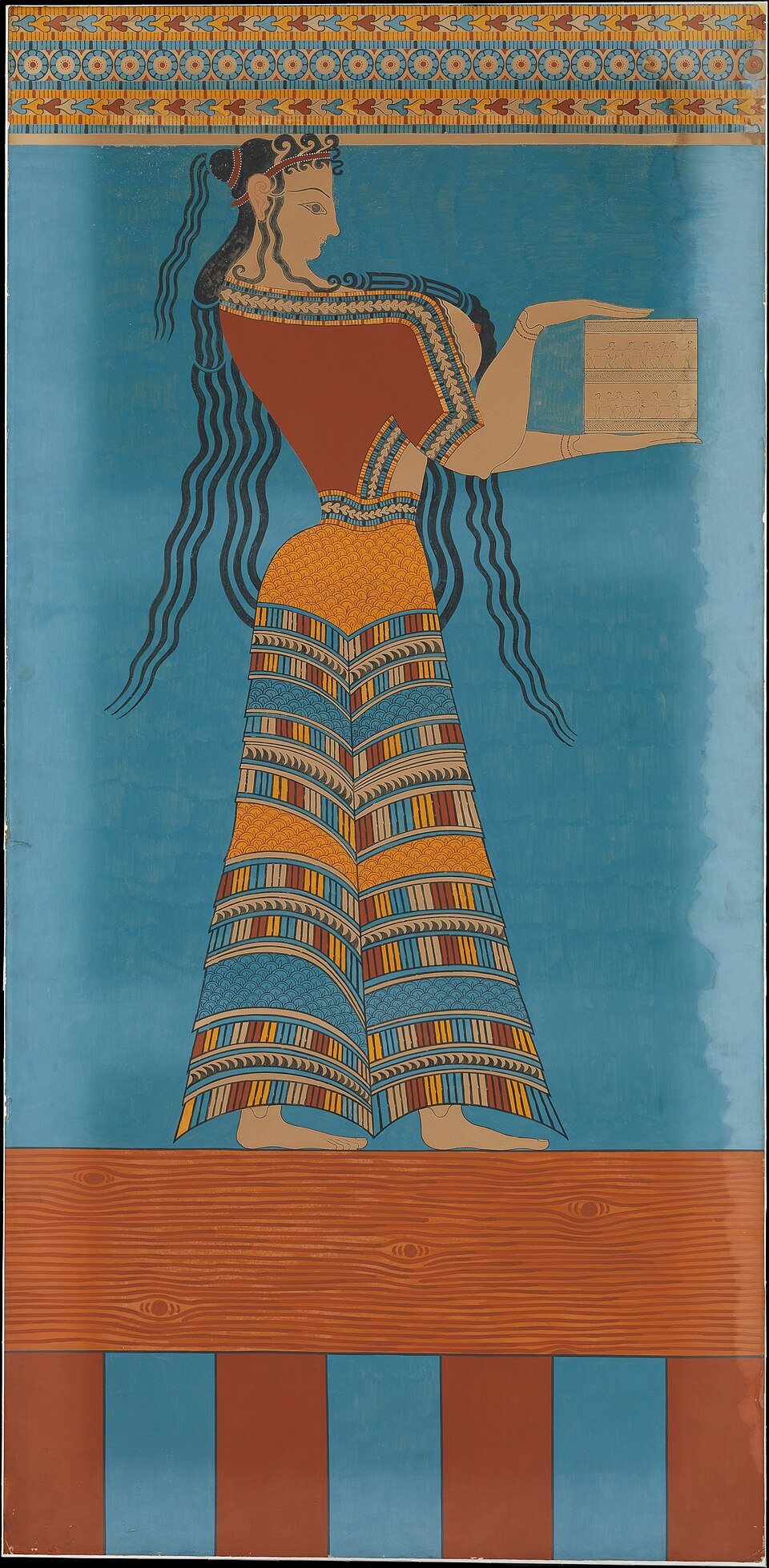
In art, women wear the flounced skirt and open bodice inherited from Crete, and men a short tunic or kilt; the tight belted waist survives on both. What the tablets add is scale and organisation. Textile work was a palace industry with a division of labour, and some of the women in the Pylos lists are identified by places across the Aegean and the Anatolian coast, which is generally read as meaning they were brought in as dependent or captive labour. Wool was the staple, flax the finer alternative, and cloth was one of the things the palaces existed to accumulate.
Two cautions. The frescoes are fragmentary and the familiar images are often modern reconstructions — the picture on this page is a Gilliéron reproduction, not an ancient surface. And the flounced costume clusters around ritual and elite scenes, so it is safer as court and cult dress than as a description of what most people wore.
Transition
When the palaces burned around 1200 BC the accounting system, the writing and the organised textile industry went with them. Archaic Greece did not resume this dress; it started again from the unsewn woollen peplos, pinned at the shoulders with fibulae, which is why those pins are so common in Early Iron Age graves.