Overview
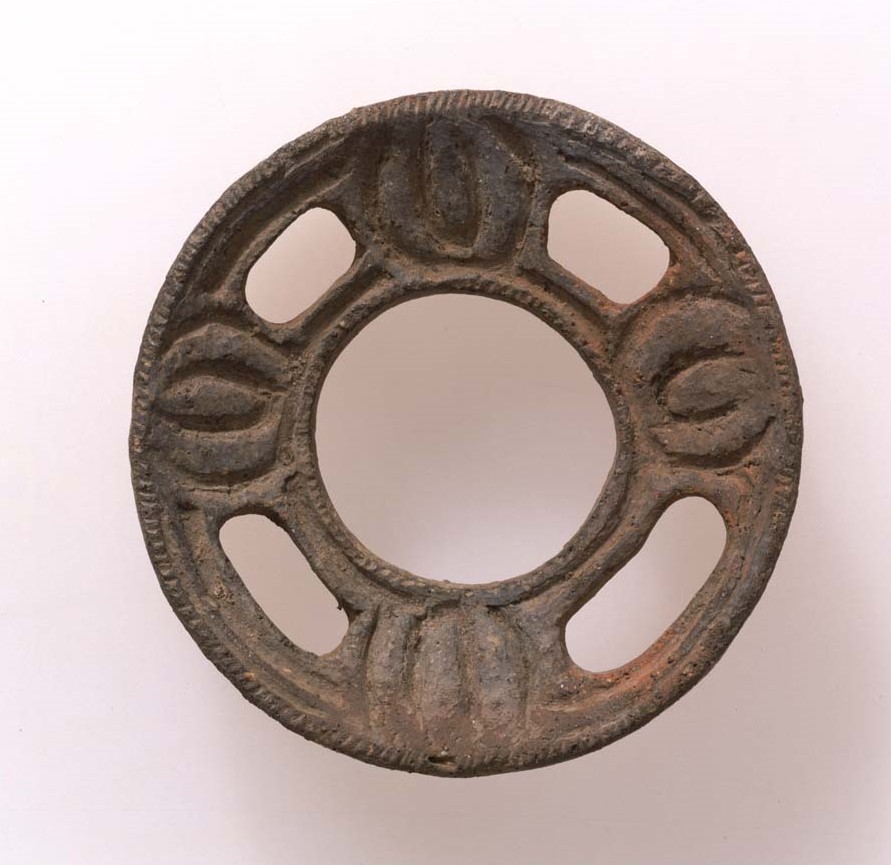
The early form is the ketsu, a ring with a single slit cut through it, made of jadeite or nephrite and polished to a shine. The slit is the whole design: the lobe is threaded through it, so the ring hangs closed around flesh rather than on a hook. From the Middle Jōmon a second tradition takes over in the east — ornaments of fired clay, worn in a pierced lobe that was stretched over years to hold them. Late and Final Jōmon examples from the Kantō and Chūbu regions reach eight centimetres across, cut through with openwork and pressed with spirals, and they are far too large to have been inserted into an adult ear that had not been prepared since childhood.
How it is worn
A slit ring goes on sideways. The lobe is pinched thin, slipped through the gap, and released, and the ring sits in the ear with the slit at the back where it does not show. A clay disc or spool is different: it cannot be opened, so it has to pass through a hole already wide enough, and pairs found in graves show the two ears matched in size. The largest are not solid — the openwork is structural as much as decorative, because a solid disc of that width would tear the lobe it hangs in. Weight is why the biggest are thin at the rim and pierced through the middle.
History
Slit jade rings appear in the Japanese archipelago in the Early Jōmon and share their form with rings from the Chinese Neolithic and the Korean peninsula, which is one of the clearest material links across that sea in the period. The clay ornaments are local and their elaboration is late: the largest and most worked pieces come from the last centuries before the Yayoi transition, and then the practice stops. Nothing comparable is worn in the Yayoi period, when metal ornament arrives and the ear is left alone.