Overview
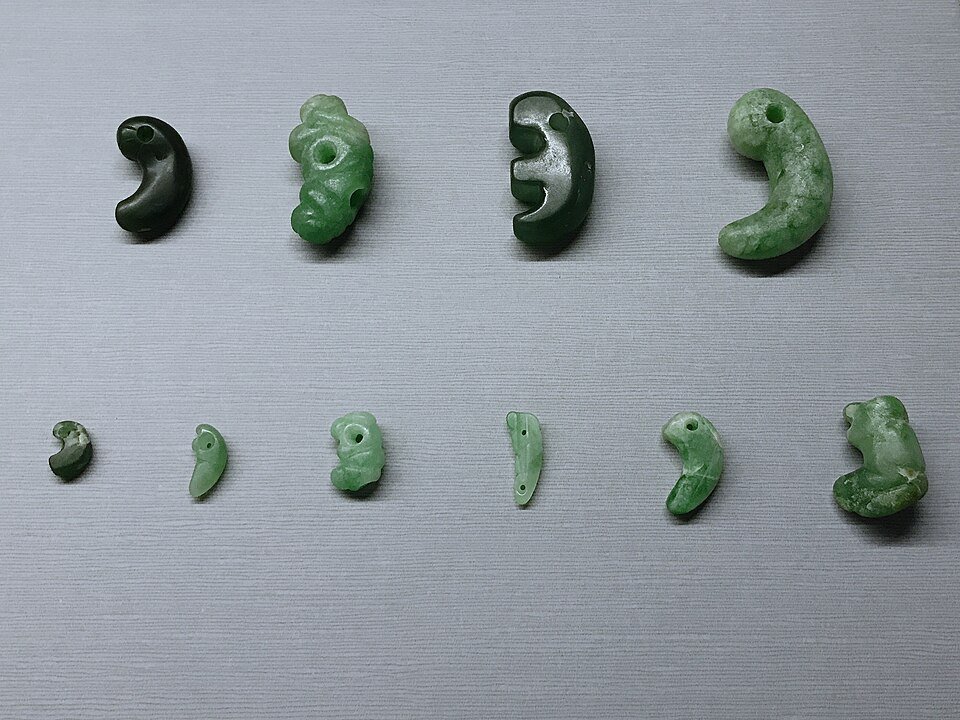
A magatama is a curved bead, thicker at one end where it is pierced, tapering to a tail — the shape that gives it its name, the curved jewel. The finest are jadeite, and almost all the jadeite comes from one place: the Itoigawa area on the Japan Sea coast, the only source in the archipelago. Others were worked from jasper, agate, talc and, later, glass.
How it is worn
Magatama were strung on cords and worn at the neck, singly as a pendant or in numbers alternating with tubular kudatama beads. They are found in graves rather than in houses, and they are found with some people and not others, so they read as a marker of standing rather than as everyday jewellery. Size and material carry the same signal: a large worked jadeite bead represented labour and a long journey.
History
The form appears as early as the Jōmon period and reaches its height in the Yayoi and Kofun centuries, when Itoigawa jade travelled the length of the country and across to the Korean peninsula, where comma-shaped beads hang from Silla crowns. Ornament of this kind faded after Buddhism arrived and burial practice changed, but the shape did not disappear: the Yasakani no Magatama remains one of the three sacred treasures of the imperial house.