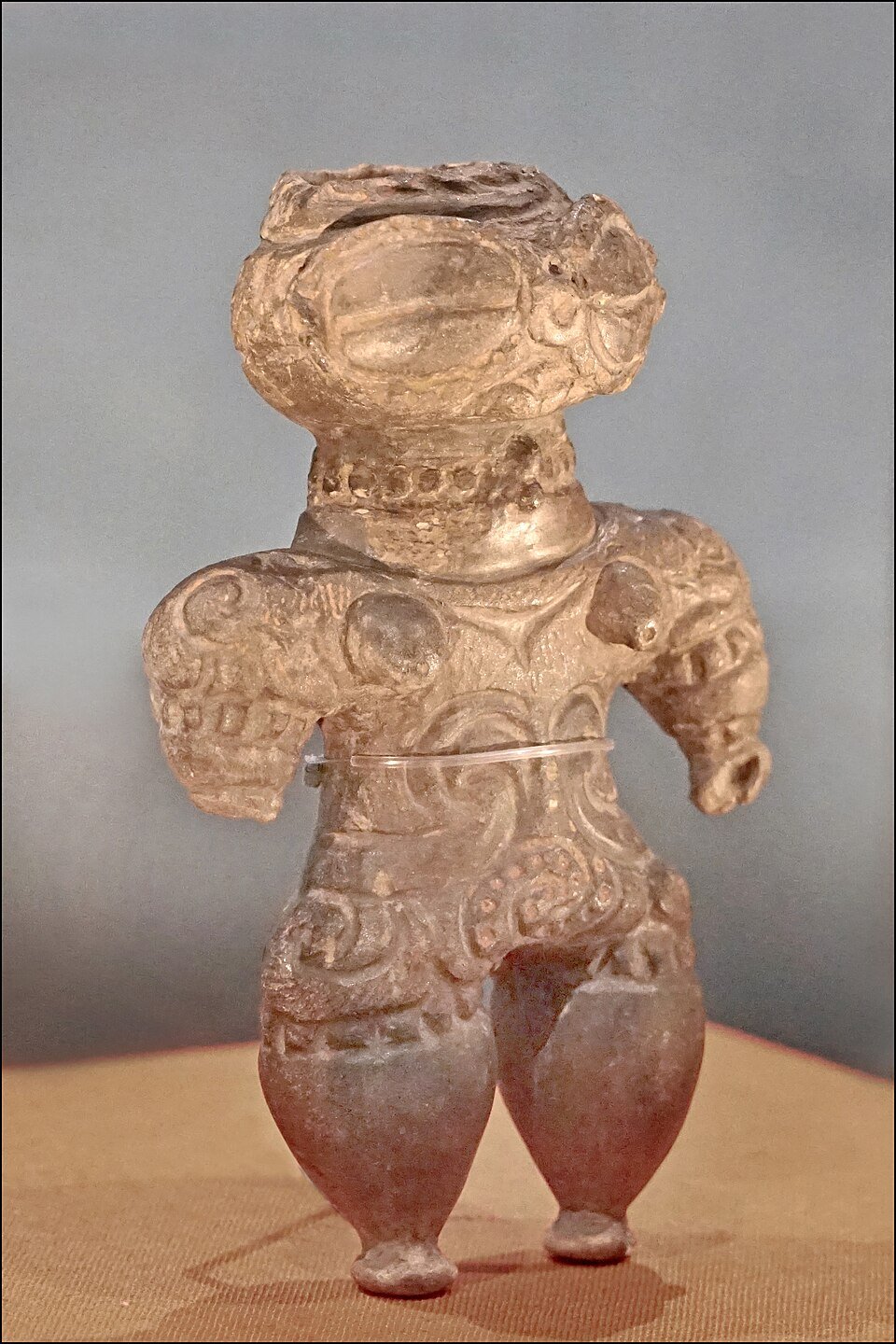
Overview
The Jōmon had thread, needles and a rich vocabulary of twining, but no loom: that arrives only with rice farming at the end of the period. Cloth was worked by hand in the same techniques as their baskets and mats, twisting pairs of fibre wefts around fixed warps. A small twined bag from Sannai-Maruyama in Aomori is the best-preserved piece of Jōmon fabric anyone has found, and it is a container rather than clothing — the garments themselves are gone, because plant fibre does not survive ten thousand years in acid volcanic soil. Waterlogged sites such as the Torihama shell midden in Fukui have given up cordage, lacquered combs and basketry, which fixes the materials and the skill but not the cut.
How it is worn
Nothing was fitted to the body. A twined bast garment is a flat rectangle, and it was worn by wrapping and tying — over one shoulder or both, gathered at the waist with a cord — with skins and fur added over it through the northern winters. Bone and antler needles show that pieces were sewn together, but there is no sign of shaping, of set-in sleeves or of a cut armhole. Ornament is the part that survives, and there was a great deal of it: jade beads traded south from Itoigawa worn at the neck, shell bracelets on the upper arm, and clay ear ornaments pushed through a lobe stretched over years to take them, the largest as wide as a plum. Whether the dense patterning carved over the whole body of a dogu figure is a decorated garment, tattooing, or both at once is still argued; the figure on this page is read by its museum as clothed.
History
The period runs from about 14,000 BC to about 300 BC, which makes Jōmon dress the longest-lasting clothing tradition in the archipelago by a wide margin, and the least visible. It ends not by fashion but by technology: wet-rice agriculture arrives from the continent with cultivated hemp, the backstrap loom and woven cloth, and the Yayoi kantoi — a single woven length with a hole cut for the head — replaces everything twined by hand.