Overview
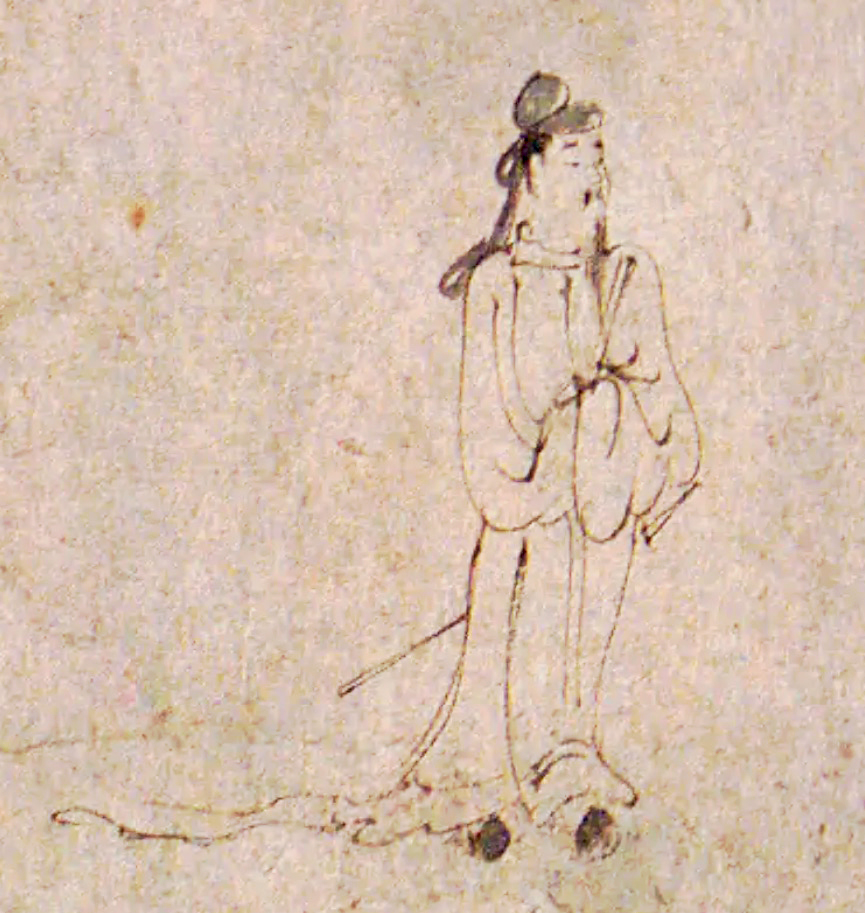
In 603 the court adopted twelve cap ranks, borrowed from continental practice, and gave each rank a colour of silk for the cap. The system put rank on the head where it could be read across a room, and it replaced inherited clan standing with a grade the court itself conferred — which is the political point of it. The caps of that first system were of cloth; the stiff lacquered form with a folded tail at the back, the shape now called kanmuri, develops later and becomes fixed in the Heian period.
How it is worn
The cap sits on a topknot and is held by a cord under the chin or by pins through the hair, so the hair does the anchoring and the cap need not grip. Behind it stands the ei, a flat tail of stiffened silk or lacquered gauze; the upright rolled ei and the drooping flat ei belong to different ranks and occasions. Because it is worn over dressed hair, appearing without it was a serious indecency at court, and paintings of disorder show men bare-headed as a way of showing disorder.
History
The Asuka system was revised repeatedly through the seventh century and folded into the ritsuryō court dress that followed, and the cap kept its meaning after the colours were reorganised. It survives today in the ceremonial dress of the imperial household and in Shinto priestly costume — one of the very few articles of seventh-century court dress still put on for its original purpose.